The client for this project was Canadore College. Although it was created in an academic setting, I approached the piece as a professional design project, developing it as an illustrated recipe poster that combined infographic thinking, cultural visual language, and strong composition. This gave me the opportunity to create something that was both informative and visually engaging, while showing my ability to communicate instructions clearly through illustration, layout, and typography.
Company
Canadore College
Timeline
2025
—
2025
Role
Graphic Designer
Project overview
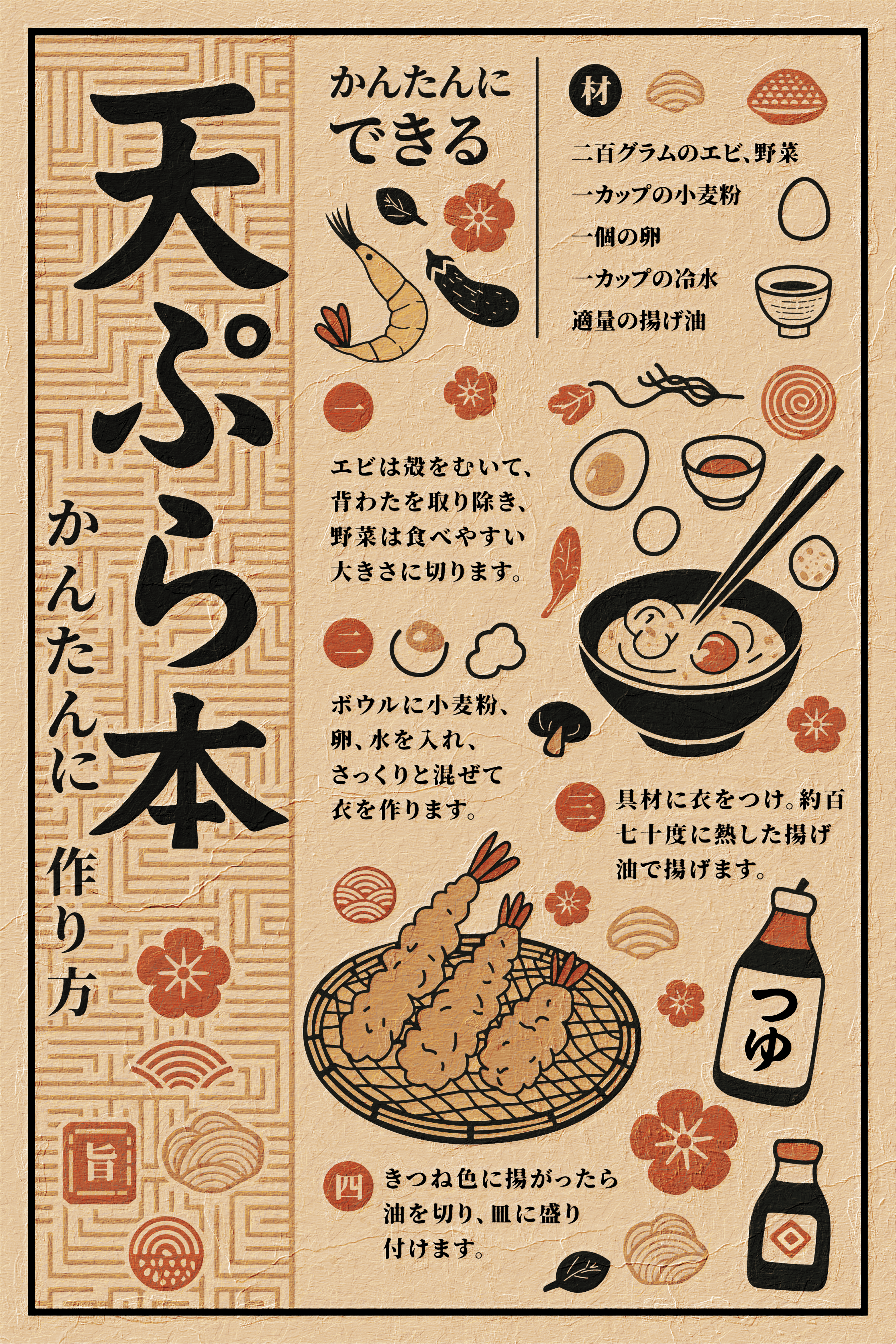
This project focused on creating a Japanese-style illustrative recipe poster that explains how to make tempura through clear visuals, icons, and step-by-step composition rather than relying only on written instructions. I wanted the piece to feel both informative and immersive, so I combined traditional Japanese-inspired design elements such as calligraphic typography, decorative patterns, warm textured tones, and simple food illustrations to create something that was easy to understand while still feeling visually rich. The final result became a poster that blends infographic design and illustration, turning a recipe into a piece that is both functional and expressive.
Challenges
One of the main challenges in this project was balancing visual storytelling with clarity. I wanted the recipe to feel authentic, decorative, and strongly inspired by Japanese design, but it still had to communicate the cooking steps in a way that was easy to follow at a glance. That meant I had to be careful with the layout, making sure the illustrations, icons, patterns, and text all worked together without making the poster feel crowded or confusing. Another challenge was creating a strong cultural aesthetic through calligraphic type, earthy colours, and textured surfaces while still keeping the piece clean and readable as an infographic. In the end, the biggest challenge was finding the right balance between function and artistry so the poster could feel both informative and visually rich.
Results
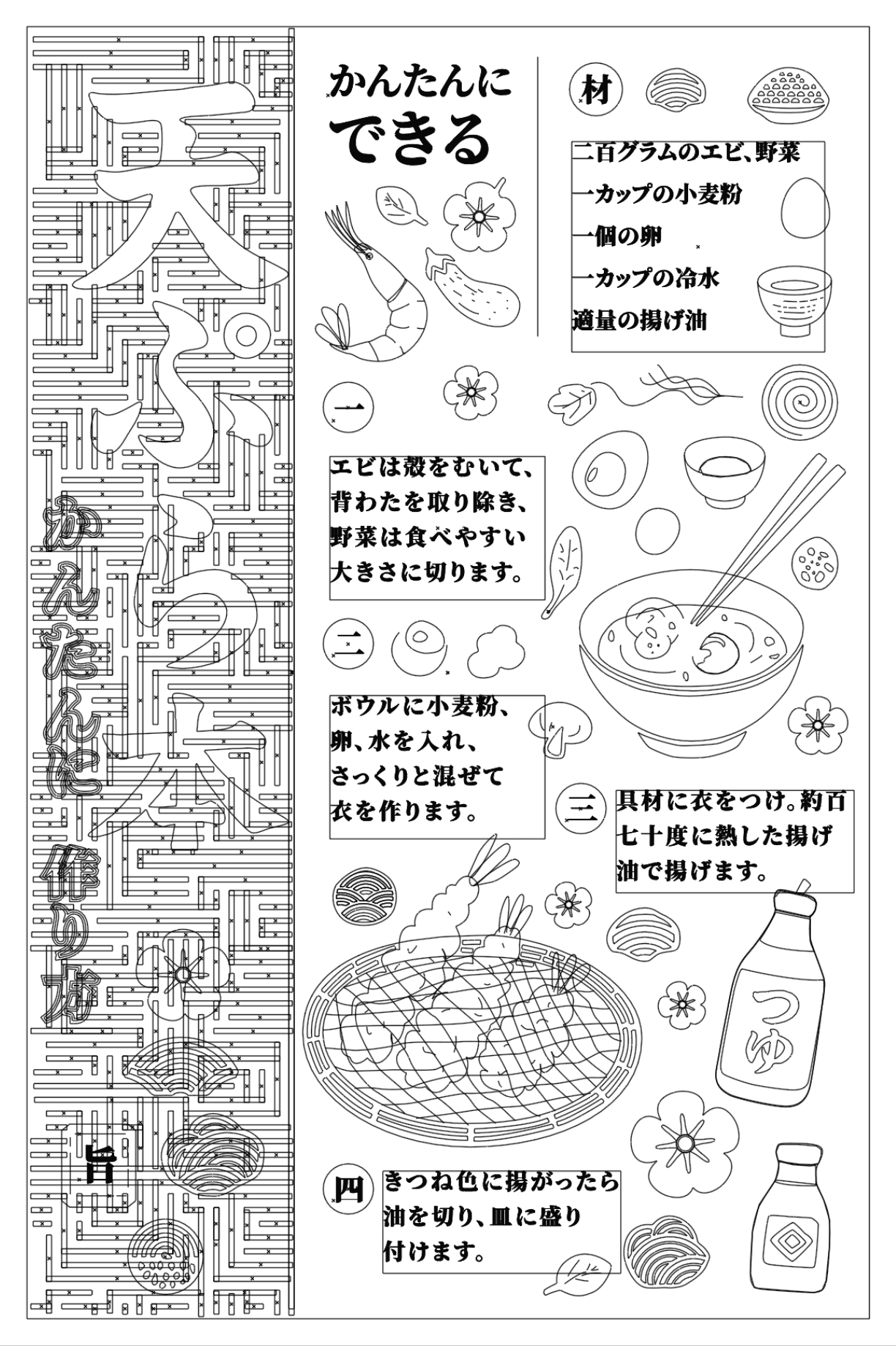
The final result was an illustrative recipe poster that successfully combined clear instruction with a strong visual identity. I was able to turn the tempura recipe into a piece that felt both functional and expressive, using illustration, layout, typography, and Japanese-inspired design elements to guide the viewer through each step in an engaging way. The project was successful because it showed how information can be communicated visually without relying too heavily on text, while also creating a finished poster that felt detailed, cohesive, and visually memorable.

The client for this project was Canadore College. Although it was created in an academic setting, I approached the piece as a professional design project, developing it as an illustrated recipe poster that combined infographic thinking, cultural visual language, and strong composition. This gave me the opportunity to create something that was both informative and visually engaging, while showing my ability to communicate instructions clearly through illustration, layout, and typography.
Company
Canadore College
Timeline
2025
—
2025
Role
Graphic Designer
Project overview
This project focused on creating a Japanese-style illustrative recipe poster that explains how to make tempura through clear visuals, icons, and step-by-step composition rather than relying only on written instructions. I wanted the piece to feel both informative and immersive, so I combined traditional Japanese-inspired design elements such as calligraphic typography, decorative patterns, warm textured tones, and simple food illustrations to create something that was easy to understand while still feeling visually rich. The final result became a poster that blends infographic design and illustration, turning a recipe into a piece that is both functional and expressive.
Challenges
One of the main challenges in this project was balancing visual storytelling with clarity. I wanted the recipe to feel authentic, decorative, and strongly inspired by Japanese design, but it still had to communicate the cooking steps in a way that was easy to follow at a glance. That meant I had to be careful with the layout, making sure the illustrations, icons, patterns, and text all worked together without making the poster feel crowded or confusing. Another challenge was creating a strong cultural aesthetic through calligraphic type, earthy colours, and textured surfaces while still keeping the piece clean and readable as an infographic. In the end, the biggest challenge was finding the right balance between function and artistry so the poster could feel both informative and visually rich.
Results
The final result was an illustrative recipe poster that successfully combined clear instruction with a strong visual identity. I was able to turn the tempura recipe into a piece that felt both functional and expressive, using illustration, layout, typography, and Japanese-inspired design elements to guide the viewer through each step in an engaging way. The project was successful because it showed how information can be communicated visually without relying too heavily on text, while also creating a finished poster that felt detailed, cohesive, and visually memorable.